
https://thesis-masters.store/wp-admin/post.php?post=184&action=edit
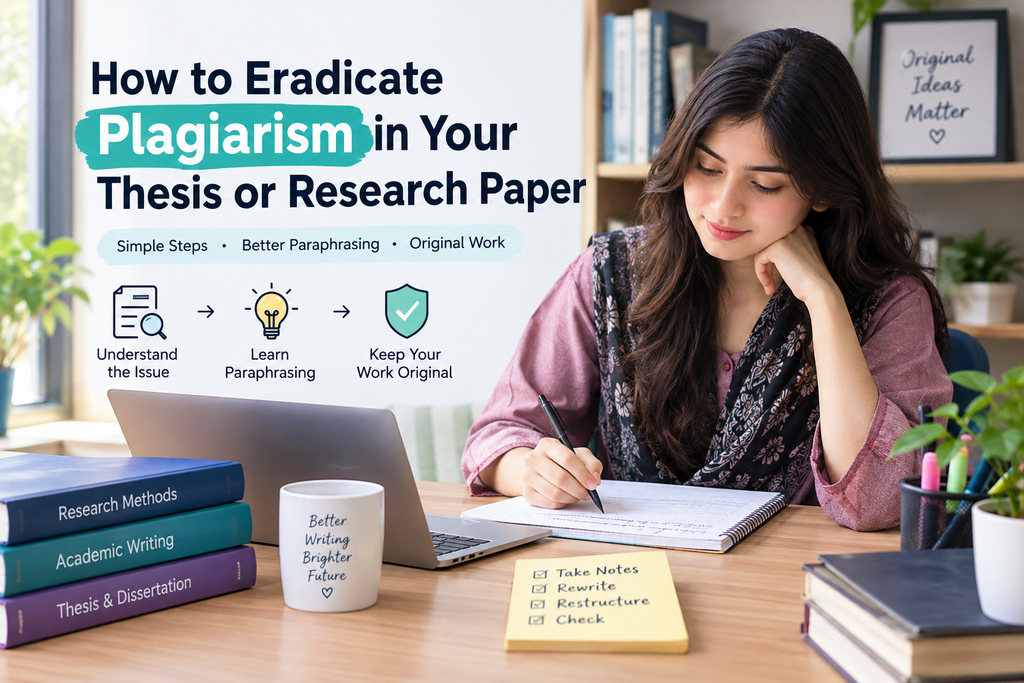
Are you worried about plagiarism in your thesis? Are you about to submit your work? If so, you probably want to avoid any issues, including patchwriting.
Step by Step to Eradicate Plagiarism
In this guide, I’ll show you exactly what to do. These steps will help you remove plagiarism from your research paper or PhD thesis.
Plagiarism has always been a big issue for students. However, it has become even more important with ChatGPT. Many people now use AI tools to help write research papers and theses.
Plagiarism Detectors Can Detect AI
Some of you may not know this. Plagiarism detectors can now flag text that looks AI-written. This applies to theses and journal submissions alike.
So, whether you use AI tools or not, you should follow the steps below. They will help you keep your writing clean and original.
No Additional Software Required
These steps need no extra software. They are simple, so you can start today. Moreover, once you learn them, you can reuse them for every future paper. As a result, you won’t have to worry about plagiarism again.
Two Types of Plagiarism
First, let’s define plagiarism. There are two main types.
The first type is intentional plagiarism. Here, you take someone else’s words or ideas and use them as your own. You know it’s wrong, but you do it anyway. Fortunately, this type is less common.
The second type is unintentional plagiarism. It happens more often, especially to PhD students and researchers.
Unintentional Plagiarism With AI Tools
With unintentional plagiarism, you don’t mean to do anything wrong. You may use tools like ChatGPT for help. You also try to credit other authors with references. Still, some of the text ends up too close to another source. In addition, AI tools have made this problem more common.
How to Paraphrase Successfully
The best defense is good paraphrasing. When you review the literature, you constantly take other people’s ideas and put them into your own words. Then you organize everything clearly in your paper.
Why Paraphrasing Matters
Paraphrasing is a key skill for two reasons. First, it protects you from accidental plagiarism. Second, it saves time. Without a method, you may spend hours swapping words and still get stuck.
Dos and Don’ts of Paraphrasing
Let’s look at what to do and what to avoid. After that, I’ll show you a poor paraphrase and a good one, so you can see the difference.
Do: Rewrite the Text Completely
Changing a few words is not enough. Instead, rewrite the text from scratch.
Do: Change the Sentence Structure
First, change the structure of each sentence. Move words around. Rebuild the sentence. Next, reorganize the whole paragraph. If you take an entire paragraph from a source, you must change it completely. Keeping the same structure with a few new words won’t work.
Do: Use Your Notes Instead
Your notes are your best tool. While reading, take notes on each study. For example, you can use the note-taking worksheet in week three of PhD Accelerator. Later, when you write, look only at your notes. Don’t look at the original text. Otherwise, you’re more likely to copy it.
Do: Fit the Text to Your Own Paragraph
Ask yourself what you want to stress. Is it the result? The conclusion? A suggestion for future research? A sentence copied from another paper rarely fits your flow. Therefore, reshape it to support your own point.
Do: Check Against the Original
Once you finish, go back to the source. Compare the two texts. This final check confirms that your version is safe.
Don’t: Just Swap Words
Replacing “substantially” with “considerably” is not paraphrasing. Likewise, changing “nevertheless” to “however” doesn’t help. Instead, change the whole sentence. Keep the idea, but present it in a new way.
Don’t: Keep the Same Structure
Don’t copy the structure of the sentence or the paragraph. It’s a common mistake, and it’s easy to avoid.
Don’t: Paraphrase While Looking at the Text
If you write with the source open, you’ll be tempted to swap one or two words. That’s because you keep asking, “How do I replace this word?” So, work from your notes instead.
An Original Text Example
Now let’s see this in practice. Below is an original passage from one of my papers. Pause for a minute and read it carefully. Then we’ll look at a poor paraphrase.
A Poor Paraphrase
Here is the poor paraphrase. Why is it weak?
There are three problems.
It has the same paragraph structure. Nothing about the layout is different from the original.
It has the same sentence structure. For instance, “the recruiters” became “the recruiters,” and “in the study” became “in the research.” Similarly, “substantially more” became “significantly more.” The order is identical.
It only substitutes words. For example, “this study” turned into “in this research.” As a result, the text looks different at first glance, but it’s still too close to the original.
What Makes a Good Paraphrase
A good paraphrase keeps the original meaning. However, it presents the information in a fresh and natural way. Now look at the example below. Notice how the wording, sentence structure, and overall presentation have changed. Meanwhile, the main idea stays the same.
Everything Is Changed
In this version, the paragraph structure is different. The sentence structure is different too. It is even shorter than the original. Most importantly, it stresses the ideas the writer cares about. That is a good thing. After all, you want the idea to fit the flow of your own introduction or literature review.
Final Thoughts
To sum up, follow these steps: take notes, write from your notes, restructure everything, and check against the source. With practice, this process becomes quick and easy. Most importantly, it keeps your thesis original.
