
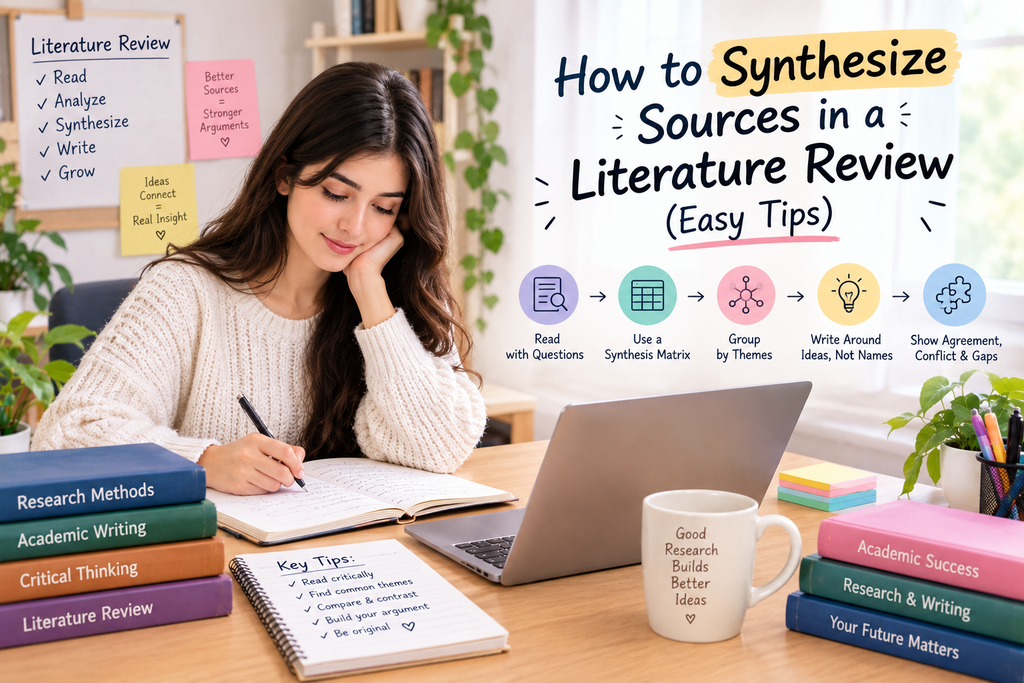
And here’s another one that happens quite frequently. The student reads ten articles and writes one paragraph for each article, naming it a literature review. It looks neat. But it isn’t really a review.
Why? Because a pile of summaries doesn’t tell the reader anything new. Your marker wants to see how the studies connect. This is what it means to synthesize information in a literature review.
No worries, it’s not as difficult as it seems. Let me take you through it.
What Does Synthesis Mean?
Synthesis just means mixing ideas from different sources to make a point. None of the sources makes that point alone. You make it by putting them side by side.
See yourself as a guide. You are taking the reader through places where researchers have an agreement, disagreement, or where no one has been before.
Here’s a simple way of thinking about it. Take for example a group chat. Summarizing involves reading out each individual message. Synthesizing involves giving an account of the discussion.
Summary vs. Synthesis: An Example
For instance, if you were dealing with the topic of social media and grades, the summary would be something like:
According to Khan (2021), excessive use of Instagram affects students’ grades negatively. Lee (2020) investigated Facebook and found no connection. Meanwhile, Ahmed (2022) examined TikTok and found that the study behavior was affected.
Three sentences. Three separate islands. Now here’s the synthesis version:
There is conflicting evidence regarding the relationship between social media usage and academic achievement. While Khan (2021) asserts that high usage levels correlate with low scores, Lee (2020) reports there is no effect. This could be due to the nature of the platform used or the methodology.
Same three sources.
Step 1:Reading With Questions
Reading every paper from start to end with no plan gets you lost fast. So decide what you need before you open a study. Is it the method? The sample? The main result?
A good question to ponder is: “Is this paper in agreement with the other papers?” Write the answer down right away. By paper number six, you’ll have forgotten it.
Step 2: Make a Synthesis Matrix
This is the easiest tool for the job. It’s just a table. List your sources on the side, and put your points along the top.
| Source | Main Finding | Method | Sample | Limitation |
| Khan (2021) | Heavy use lowers grades | Survey | 400 students | Self-reported data |
| Lee (2020) | No link found | Experiment | 120 students | Small sample |
| Ahmed (2022) | Study habits change | Interviews | 30 students | Narrow group |
Now read down each column instead of across the rows. Patterns show up quickly. Maybe the big studies agree and the small ones don’t. One would never notice that when reading papers one by one.
Step 3: Thematic Grouping of Sources
Organize the sources conceptually rather than by authorship. Three or four themes are sufficient. Each theme becomes a section or a paragraph later.
For our example, you could have studies that find a bad effect, studies that find no effect, and studies that explain the difference. One source can go in two groups. It’s absolutely okay.
In case you have trouble with the organization of your literature review, make sure to check this out first.
Step 4: Write Around Ideas, Not Names
This is where the majority of drafts go wrong. Examine your paragraphs. Do almost all of the sentences begin with the name of an author? Then you are summarizing yet again. Now turn it around.Start with the thesis statement followed by references.
For instance, “As per Khan (2021), phone addiction has an effect on sleep” will be changed to “Phone addiction influences sleep, which in its turn leads to poor academic achievements (Khan, 2021; Ahmed, 2022).”
Notice the difference? The second sentence is making an assertion. It is also using two sources at one time.
Step 5: Show Agreement, Conflict, and Gaps
A strong review does three things. It shows where sources agree. It shows where they clash. And it points out what’s missing.
Small linking words help a lot. “similarly” and “likewise” indicate agreement. “However” and “in contrast” show a clash. “As a result” and “because of this” show cause.
But don’t just point out a clash and move on. Explain it. Did the studies use different samples? Different years? Different countries?
And if every source skips the same question, you may have found a gap. That gap can become your own research question. Once your themes are ready, it’s worth learning about finding a research gap.
Mistakes to Avoid
There are some errors that tend to recur.
The biggest one is summarizing source by source. Another is using too many quotes. Paraphrase everything else, and use quotations for language that is especially significant.
Some students also hide studies that disagree with them. No. Conflict is important. It adds value to your review.
Weak sources are a problem too. Synthesis is only as good as the material you use, so always pick reliable, up-to-date sources.
Lastly, there’s the missing argument. Without a main point, you only have a list of citations.
A Final Scan Before Submission
Read through your draft once more and ask yourself a few questions. Is each paragraph making a single point? Do most paragraphs use more than one source? Did you explain why studies disagree? Can the reader tell what’s still unknown?
If most answers are yes, you’re in good shape. And if you want the full process from start to end, our step-by-step literature review guide covers it.
Final Thoughts
Let’s be real. The first literature review is never going to be perfect. The first time that you try synthesizing sources in the literature review, the result is likely to read more like an unconnected series of summaries. Almost everyone starts there.
Don’t stress about it. Make a small table of your sources. Find two or three big ideas that keep showing up. Then pick one idea and write about it, using two or more sources together.
Read that paragraph back. Does it make a point, or does it just list what people wrote? If it makes a point, you’re on the right track.
So try it today. Take one paragraph from your draft and fix it. Just one. You’ll feel the difference.
