

AI technologies can make academic research much faster through most processes involved. AI technologies may assist in locating relevant papers, connecting related research, comparing findings, and detecting weaknesses in the draft of an academic paper. It should be noted that AI is useful as long as it is possible to verify the results of its work. Chatbots are okay for brainstorming.
Still, they should not decide which sources you read or cite. They can invent references or misstate what a paper says. So, always open the original paper and confirm the claim yourself.
Review Your Research Draft Before Submission
Before you send a manuscript, conference paper, or report anywhere, review it. A pre-submission check can catch unclear arguments, weak methods, poor structure, and claims that lack evidence. Tools such as thesify Reviewer are built for this stage. This allows you to deal with the issues that a reviewer will point out.
What Constitutes an Effective AI Tool in Academic Research?
An effective tool should do one research job effectively and also allow validation of its outcome. Ask yourself two questions. First, does it fit the job, such as finding papers or comparing studies? Second, can you trace every answer back to a real source? If not, the tool creates more work than it saves.
How We Assessed These Tools
Each tool was judged on six points:
- Traceability: Can you link a claim to the original paper?
- Reliability: Does it lower the risk of fake or weak citations?
- Research function: Does it support a clear task?
- Workflow value: Where does it fit in your process?
- Verification effort: How much checking do you still need to do?
- Cost: Is the free plan actually useful?
Best Free AI Tools for Finding Research Papers
The discovery stage sets the quality of everything that follows. Therefore, choose tools that search scholarly databases instead of the open web. Weak sources at this point will cost you time later.
1. Consensus
Consensus is an AI search engine built on peer-reviewed literature. You ask a focused question, and it shows relevant papers with a summary of what the evidence suggests. Its main feature is a visual indicator showing whether studies lean toward yes, no, or mixed results.
It works best for testing a narrow claim quickly. However, the free plan limits deeper features, so heavy users may need to upgrade. Check the current plan details on the official site.
2. Elicit
Elicit goes beyond simple searching. It helps you pull details from many papers and place them in a table. For example, you can compare methods, sample sizes, or outcomes side by side.
This makes it a strong choice for literature reviews. On the other hand, its most powerful features sit behind paid plans. The free version is enough to try the workflow.
3. Semantic Scholar
Semantic Scholar is a free academic search engine that provides brief abstracts, citation indicators, alerts, and paper recommendations. As a result, it is ideal for building your first reading list.
It is weaker at comparing studies. So, use it to find papers, then move to another tool for analysis.
4. Perplexity (Use with Caution)
Perplexity is a general answer engine, not a scholarly database. This will allow you to learn new terminologies or discover related subjects. Nonetheless, it must not become your sole source for writing down a bibliography. Rather, use it to get a head start and validate everything in a professional database.
Best AI Tools for Literature Review and Citation Mapping
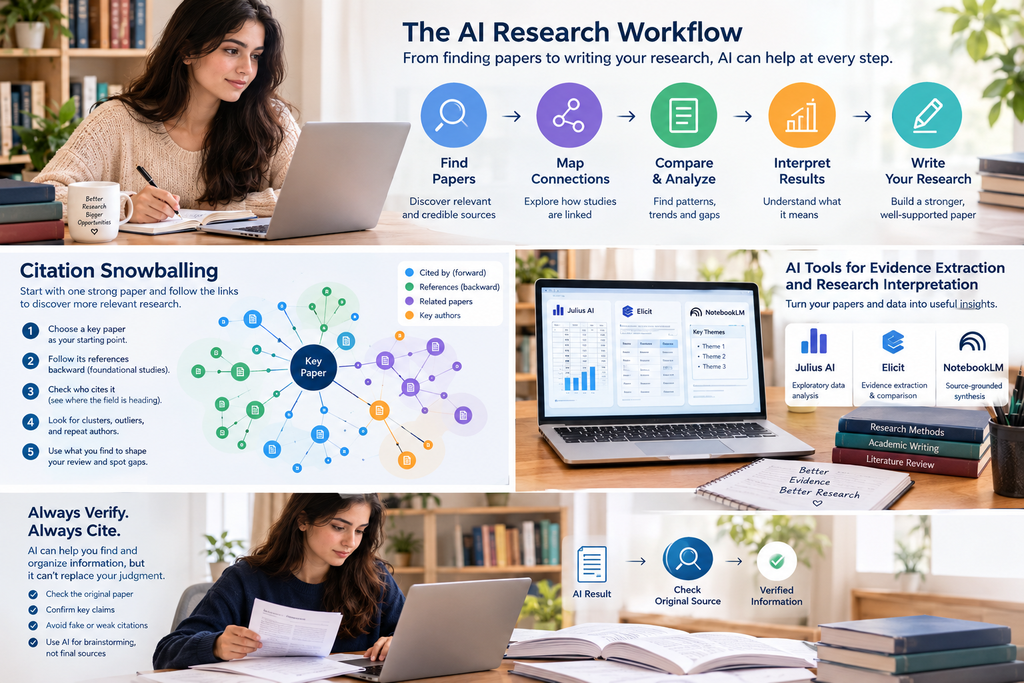
Keyword searches have a clear weakness. You can only search for words you already know. If a subfield uses different terminology, relevant papers stay hidden. Citation mapping solves this by following links between papers instead of matching words.
Citation Snowballing
Snowballing means growing your reading list from one strong paper. Follow these steps:
- Select one current and highly pertinent paper as your starting point.
- Trace its references backward to find the foundational studies.
- Trace papers that cite it to see where the field is heading.
- Look for clusters, outliers, and authors who appear repeatedly.
- Use what you find to shape your review and to spot missing counterarguments.
The Literature Mapping Matrix
| Tool | Best for | Strength | Limitation |
|---|---|---|---|
| Litmaps | Visual discovery | Clear, customizable citation maps over time | Free plan has usage caps |
| Connected Papers | Field overview | Groups papers by similarity | Needs a single seed paper |
| ResearchRabbit | Ongoing discovery | Recommends papers based on your collections | Interface can feel busy |
| Inciteful | Fast exploration | Finds links between different fields | Fewer visual options |
All four offer free access. Pricing varies frequently; therefore, check your current restrictions.
How to Choose a Citation Mapping Tool for Literature Review
Your choice depends on your goal.
- Litmaps suit you if you want to see how a specific set of papers connects over time.
- Connected Papers works well when you have one good paper and want a quick picture of related work.
- ResearchRabbit fits long projects, since it keeps suggesting new papers as your collection grows.
- Inciteful helps when you want to link two different areas and find a research gap.
Best AI Tools for Evidence Extraction and Research Interpretation
Once you have your papers and your data, the task shifts from finding to understanding. AI can support this stage. Even so, it does not replace statistical software or careful qualitative coding. It simply helps you explore and organize.
Julius AI for Exploratory Data Analysis
Julius AI lets you upload a spreadsheet and ask questions in plain language. It then produces charts and quick summaries without any coding. This is useful for spotting outliers or testing early patterns. However, it is not suitable for final statistical reporting.
Elicit for Evidence Extraction and Study Comparison
Elicit also fits here. It turns a pile of papers into a comparison table, with details linked to their sources. Consequently, you can move from reading to synthesis much faster. It is especially helpful when preparing a systematic review.
NotebookLM for Source-Grounded Synthesis
NotebookLM works only from the documents you upload. You can add papers, notes, or interview transcripts, then ask for themes and connections. Because it stays within your sources, it is less likely to wander off-topic. Its quality, though, depends entirely on what you upload.
Limitations of AI Tools for Research Interpretation
AI is good at spotting patterns, building tables, and drawing charts. Yet it cannot tell you why a result matters. It also cannot place your findings inside a theoretical framework. That thinking is your job. Use AI to organize evidence, but write your discussion section from your own expertise, and paraphrase sources carefully to avoid plagiarism.
Conclusion
Artificial intelligence can expedite academic research almost at every stage. This technology assists in finding articles, mapping references, comparing researches, and compiling information.
Consensus, Elicit, and Semantic Scholar work well for discovery. Litmaps, Connected Papers, ResearchRabbit, and Inciteful help you map the field. Meanwhile, Julius AI and NotebookLM support the move from reading to understanding.
Still, one rule applies to every tool. Always trace each claim back to the original paper. Chatbots and general answer engines can invent references or misstate findings . Hence, they should only be used for brainstorming purposes, and all the information needs to be verified in a scholarly database..
In addition, remember what artificial intelligence cannot do. First, it cannot justify the importance of the results. Second, it cannot situate your results within a theoretical framework. This needs to be done by yourself. Use artificial intelligence to make the process faster, and then devote more time to critical thinking.
