
Introduction
For most students, doing a research paper is something that makes them panic.I see. The page is blank, time is running out, and there’s nobody there to tell you where to begin. Let’s change that.
Here’s how to write a research paper without panicking. You don’t need a special talent. You need a procedure.Divide the assignment into ten small parts and do each separately and your writing will just come to you.
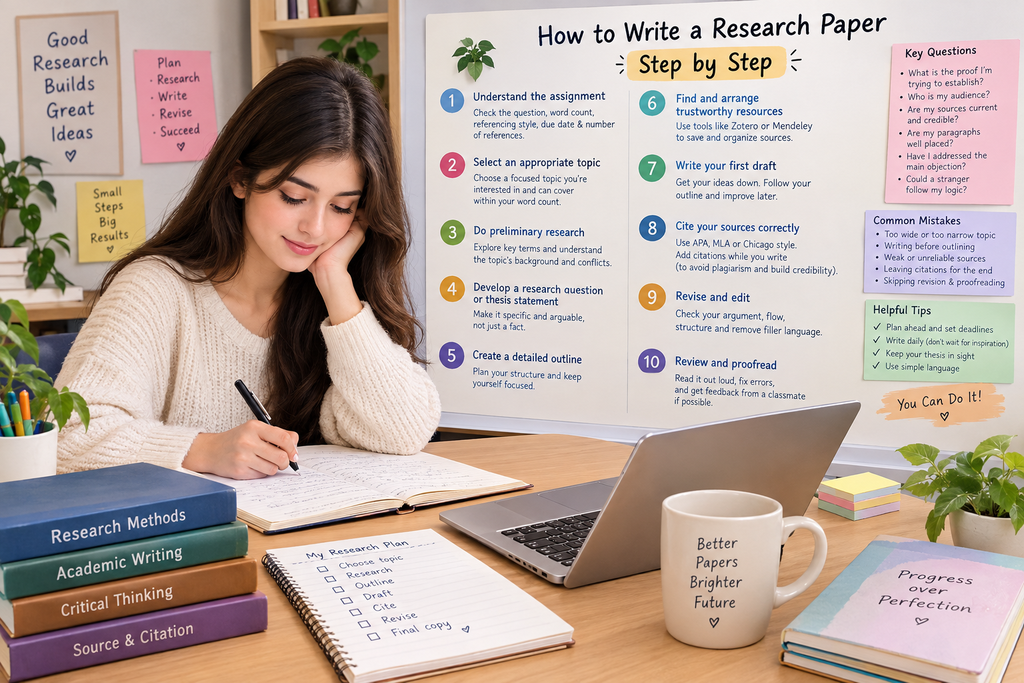
How is a research paper supposed to be written?
Do it step by step. Researching is done before writing. Editing follows drafting. If students jump a step in the process, they always make up for it later through a poorly made argument or a hastily done rewrite.
1. Understand the assignment
Look at the question twice. Highlight this when you have read through the essay twice. Write down the word count, referencing style, due date, and number of references.
Consider the verbs also. “Analyze,” “compare,” and “argue” require something different from each other. Got a doubt? Don’t wait until the night before to send your teacher an email.
2. Select an appropriate research topic
Big topics break papers. “Climate change” could fill a library. “”How Rising Sea Levels Affect Fishing Villages in Bangladesh” occupies twelve pages.
Pick a topic you have an interest in because you will be working on it for weeks. Shrink it. Keep asking yourself: “Can I write about this within my word count?” Otherwise, narrow down the scope.
3. Preliminary research should be carried out.
You have not begun collecting the sources yet. You are still learning the language and finding out the recurring conflicts.
List the terms that pop up in your head. It will be helpful for formulating the search later on.
4. Develop your research question or thesis statement
The thesis is the framework of the essay. It should be stated in one or two sentences and it should be an arguable one.
Compare these two lines. “Sleep is important for students” is a fact nobody argues about. “Using phones in bed lowers sleep quality in first-year university students” is a claim you can test and defend. Pick the second kind.
5. Develop a comprehensive outline
This is just like mapping out your trip. Your field may tweak that order. What may be said about this is that having an effective outline makes sure that one remains focused and helps to pinpoint the gaps in the information.
6. Find and arrange trustworthy resources
Now dig in. Save every source the moment you find it. Zotero and Mendeley both do this for free. They’ll also format your bibliography later, which saves a surprising amount of stress.
7. First Paper Draft
Begin by getting your thoughts down on paper without trying to make everything absolutely perfect at once. Improvements in the quality of writing can always be done later, but you need a draft first in order to do any revision at all. Work according to the outline you’ve created, completing each section of the paper.
There are some who feel that it is best to begin with the body of the paper before writing the introduction, as their vision of the paper becomes clear when they complete the body of the paper.
8. Cite your sources correctly
When the idea, number, or quote belongs to somebody else, give credit to him. There is no exception to this rule at all. You can choose between APA, MLA, and Chicago styles depending on your teacher’s requirements.
Don’t leave citations for the final night. Add them while you write. That takes seconds when you cite immediately but hours when you don’t. Proper citations not only help to avoid plagiarism but also ensure credibility of your arguments.
9. Revise and edit your paper
Does the argument hold together? Do the sections flow in a sensible order? Does every paragraph support the thesis? With your efforts done on structure, it is now time to focus on the sentences. Avoid all filler language and use exact terms.
10. Review and edit
This is your last proofreading. Try reading the paper out loud. Your ear will catch clumsy sentences that your eyes skip over. A classmate can help too. When it reads cleanly, hand it in.
Using key questions to improve your research paper
Questions are a quick quality check. Ask yourself these while you work:
- What is the proof that I am trying to establish?
- Who will be reading this, and what is their background knowledge?
- Are my sources current and credible?
- Are paragraphs justified in their placement?
- Have I addressed the most compelling objection?
- Could a stranger follow my logic?
Stuck on one? This part requires further improvement. Please go ahead and reconstruct it.
Common mistakes and tips
Students continue making the same mistakes every year. Most mistakes can be avoided.
Common mistakes
- Picking a topic that’s far too wide or far too narrow
- Writing before outlining
- Leaning on weak, old, or unreliable sources
- Leaving citations until the end
- Skipping the revision and proofreading steps
Helpful tips
- It is wise to plan ahead and set deadlines for each of the assignments.
- Don’t wait for an instant flash of inspiration; rather, try writing daily.
- Do not let your thesis go out of sight.
- Go for simple language.
Conclusion
Your first paper will feel slow. This time, it will be much easier. Pick your subject and open a new document to begin step number one.
