Qualitative Research Interviews Sound Simple
Qualitative research interviews sound simple. You’re just talking to people, right? But then the reality hits.
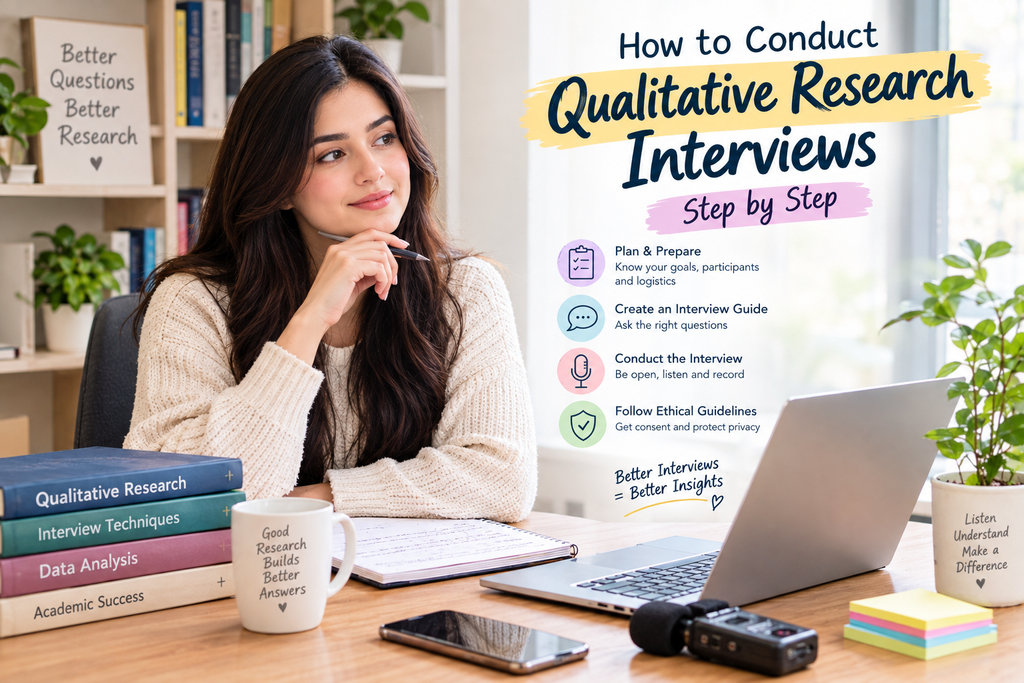
How to Conduct Qualitative Research Interviews Step by Step
You start wondering, “Who should I ask? What if they give one-word answers? What if the interview is awkward or, worse, totally useless?” Today I’m going to walk you through how to conduct qualitative research interviews step by step in a way that actually works. I’m basically going to give you practical advice that you can actually use.
Planning and Preparation
Alright then, let’s dig right in. Therefore, the first step in doing interviews is the preparation stage.
What Am I Actually Trying to Find Out?
But before anything else, we have to talk about preparation, since the majority of interviews would be doomed to failure from the very start. The very first question that you should be asking yourself is: What do I really want to learn? Good preparation is one of the most important parts of successful qualitative research interviews.
You Need to Know Your Participants
Not your broad topic, not your thesis title, your real research questions. If you’re not clear on that, your interview questions will be all over the place and your data will be a mess. Next, you need to know your participants.
Think About Logistics
Who are they? Why specifically? What experiences do they have that matter for your research? Then think about logistics. Where will the interviews be happening? Will they be in person? Will they be online? Will they be in a quiet space, comfortable?
The Right Recording Devices
And also, you have to make sure you have the right recording devices and an environment that encourages clear recording. You have to ensure that you also inspect your recording devices before interviews so that you have clear ways of capturing what your participants are telling you.
Develop an Interview Guide
https://methods.sagepub.com/book/mono/embed/doing-interviews-2e/front-matter/i171
In preparation, you also want to develop an interview guide. This is not a script but rather a guide. The following is simply a list of questions that will assist you in your interviews. It does not imply that all questions have to be asked verbatim; however, some guidance will be needed during the interview process.
Speak Your Practice
This guide should help you and not constrain you.
You need to practice out loud with your interview guide even before you conduct your interviews. Go and take some time to say the questions that you’re asking out loud.
Are You Overwhelmed by Qualitative Data Analysis?
If the questions sound weird, then you need to edit those and make them better as part of preparation for qualitative interviews. Are you overwhelmed by qualitative data analysis?
Two Specialized Services Tailored Just for You
I’ve got you covered with two specialized services tailored just for you. But before I tell you of my services, let me first begin by informing you that I have an average five-star rating from the previous clients that I’ve worked with, both in the done-for-you and in the consulting service.
The Done-for-You Qualitative Data Analysis Service
Now, here are the two services that I provide to help you in analyzing your qualitative data. The first service is the done-for-you qualitative data analysis service. In this service, I handle the heavy lifting so you can focus on the bigger picture.
Meticulous Manual Coding
My service includes meticulous manual coding, where I code every word for meaningful insights; the development, where I identify patterns that matter the most; data visualization, where I provide stunning visuals to tell your data story; findings report, where I provide a ready-to-use findings report for the fourth chapter of your thesis or dissertation; and a walkthrough video recording, which is a step-by-step explanation of how I analyze your data using Max QDA.
One-on-One Max QDA Consulting
The second service I provide is one-on-one Max QDA consulting. In this service, we hop on a video call via Microsoft Teams or Zoom, and in just a few hours, I’ll help you become a Max QDA pro. Whether you are a beginner or looking to refine your qualitative data analysis skills, I’m here to guide you every step of the way.
Let’s Talk About Ethics
So, don’t wait. Contact me today. The second issue I want to review in conducting interviews is ethics. Let’s talk about ethics.
Always Get Informed Consent
Since qualitative interviews include the actual life stories of actual individuals, ethics becomes crucial here. Always obtain informed consent from your interviewees. So, they should know what your study is, what they are being asked to do, that they can stop at any time, that there is no pressure to conduct their interviews, and that confidentiality will be kept and all the responses that they will provide will not be traced back to them so that you won’t identify them.
No Names, No Identifying Details
It’s important to explain to participants how the data will be anonymized: no names, no identifying details. And if you are working under ethics approval, especially from your university, you have to follow it. There’s no need to improvise when it comes to ethics and hope for the best.
How You Build Trust
Ethics are not just paperwork that you fill when conducting studies. They are how you build trust, and the better trust you build with your participants, the better data you collect. Now, I want to look at building rapport.
Build Rapport With Participants
The most important part of qualitative interviews is to build rapport with participants. We have to make sure that participants feel comfortable so they open up and provide us with the necessary responses that we need. It’s important for interviewees to appear human, so small talk is not a waste of time during interviews, and introducing yourself and trying to make the interviewees feel comfortable.
Thank the Interviewees for Being There
It’s important to relate well, especially when beginning interviews, so that we can lower the pressure. So, there is a need to thank the interviewees for being there. Acknowledge their time. Explain what’s going to happen.
Do Not Rush Your Participants
It’s also important that you do not rush your participants. You often give them time and remain silent so that they can think, and you can allow them to highlight all their ideas.For one who conducts interviews, it must be known that one’s role is not to awe one’s interviewees. One’s role is to make them convey whatever they have gone through, and it is one’s role to make them say everything and record it.
Asking Good Questions
Another important element about qualitative interviews that I want to look at is asking good questions. In qualitative research interviews, we have to always ask open-ended questions. So, if you have questions that can be answered with yes or no, they are probably not great qualitative questions.
Could You Please Share Your Experience With The Program?
Thus, in place of “Did you like the program?”, it is better to ask the program participants, “Could you please share your experience with the program?” This is the difference between the questions: while for one they give a simple answer, either “yes” or “no”, for the other one they have to explain their experience thoroughly.
Avoid Leading Questions
It’s also important to avoid leading questions. Don’t put your opinion into the question. And of course, always ask one question at a time.
Ask Them One Question at a Time
For example, don’t ask participants, “How did you feel about the policy, and how did it affect your work, and what would you change?” Those are three questions. Ask them one question at a time. If you ask more than one question at a time, your participant will forget the first question.
Probes Are Very Important
Also, probes are very important in qualitative interviews. If someone gives you a short answer, follow up with, “Can you tell me more about that? What do you mean by that? Can you give me an example?” That’s where you will get more details that will be appropriate for your qualitative interviews.
Start With Warm-Up Questions
Now, let’s look at the process of conducting a qualitative interview. So, let’s assume you are in the interview and you’ve pressed record and you are doing research. You need to begin with simple questions when conducting an interview. It is necessary for you to begin with warm-up questions.
Be Open Minded
Throughout the interview process, be open-minded. If the participant brings up something unexpected but relevant, follow it up. Don’t just ignore it. This is because some of the best insights come from moments you didn’t plan.
Keep an Eye on Time
While at the same time, don’t forget about the time factor. In case your interviewees digress too far from the subject, it would be appropriate to get them back on track. You may say, for example, “That’s very interesting. Let us return to what you said a little while ago.”
Anything Else You Want to Say?
Also, towards the end, you should ask your interviewees, “Is there anything else you want to say?” That question alone can save your analysis, and it can give you more data that can genuinely help you in your qualitative interviews. In conducting interviews, we also need to do recording and transcription.
Recording and Transcription
These days, it’s very easy to record and transcribe your interviews, even in real time, with tools such as AAI and other AI tools, which provide nearly 95% accuracy in recording and transcribing your interviews. So, it’s important to leverage these tools. These are the main issues that we have to consider when conducting qualitative research interviews.
Feeling Stuck With Your Data Analysis Chapter
Remember, if you are feeling stuck with your data analysis chapter, don’t stress. I’m here to help. I offer done-for-you qualitative data analysis using Max QDA, and my done-for-you service includes coding, theme development, and visualization. On the other hand, if you prefer to learn and do the analysis yourself, I provide one-on-one Max QDA consulting, where I’ll guide you step by step to master QDA in performing qualitative data analysis.
Thank you.
